Sunday, November 7, 2010

Unexpected Pumpkin Exploration


One autumn morning a friend brought a pumpkin to school. "This is my pumpkin." We have been learning about autumn for a while and what else makes you think autumn like a round, orange pumpkin? The pumpkin was a great conversation piece in our class not to mention a wonderful sensory experience. Add a few good open ended questions and we found much more than just seeds inside of this pumpkin experience.
  • So what do we know about pumpkins?
"Pumpkins are orange and round." "This pumpkin is heavy." "When I went to the ice cream store with my mommy I saw a pumpkin there." "I have a pumpkin at home, it's on the stairs." "I go to a pumpkin patch and I saw a LOT of pumpkins there. Pumpkins grow on the ground and they was dirty, we has to clean them." "I see a pumpkin and it was HUGE!" "I don't have a big pumpkin I have a little, tiny pumpkin." "This pumpkins is not huge."
  • What do you think is inside of the pumpkin?
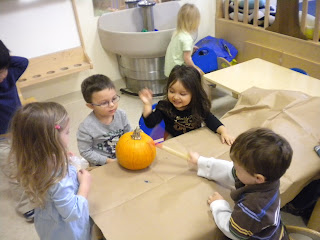
"Open it!" "I don't know." "My daddy, he open a pumpkin and I see there is SEEDS inside!" "Can we open this pumpkin ?" "Can I open it?" "No the pumpkin is too hard." "We need a knife."


  • Do you think there are seeds inside of this pumpkin?

"YES!" "I want to see the seeds!" "We going to open the pumpkin!" "Be careful Morah." "The knife is sharp, you can get a boo boo." "I don't touch the knife, only Morah can touch the knife."

"What is it?" "Wow LOOK there's seeds!" "So many!" "What are we going to do now?" "Can I touch it?"


"Lets take it out!" "Can we do that?" "Yes?" "I want to do that." "There's more seeds!" "What's that?" "It's pumpkin?" "Orange, squishy pumpkin!?" Giggles, giggles, giggles....


"It's squishy." "It's wet." "It's yucky-squishy, I don't want to touch it." "I want to touch it." "It's squishy orange." "I like pumpkin." "Can I eat it?" "It's food?" "No, you have to cook it first, right Morah?"

"Is it empty?" "No there's some more." "I want to get it." "Can you help me?"

"Now it's empty." "We cleaned the seeds." "That was fun." "I want to do it again!" "Yeah, lets do that again!" :)

Thursday, November 4, 2010

Toddlers in Autumn

Autumn is a time associated with wonderful things like back to school, festive holidays, harvest and changes in weather and natural landscape. Naturally, the themes and icons that we are learning about in this autumn unit include changes in nature, leaves, hibernation, animal migration and preparation.

So how can toddlers authentically learn about and experience autumn?
- With whole bodies, all senses, lots of fun exploration and a bit of imagination.

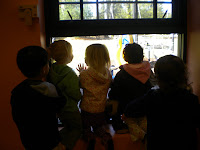
We began our autumn unit by first discussing what we know about the summer. The information and experience was fresh in children's minds and they all had lots to share. The discussion naturally lead to noticing that it's not as hot anymore and we are now wearing different clothes than we did in the summer. That is because it's not summer anymore it's autumn time now. So what is autumn? What does it look like? How can we tell it's autumn? How can we learn more about autumn? We love books and they're great for learning about new things so we read a book about autumn and learned that signs of autumn are all around. We then decided to take a look outside our window to see if we can notice any changes in nature.

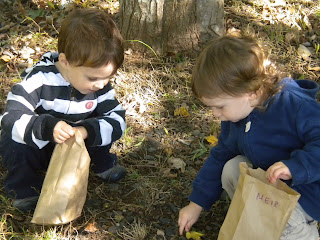
Through the window things still looked pretty much the same as they did in the summer. We needed to take a closer look and investigate the outdoors hands on. Before going on our nature walk we remembered from the book and talked about where to look when looking for signs of autumn. We also brought explorer bags outside with us so we could bring some evidence back to class for further investigation.

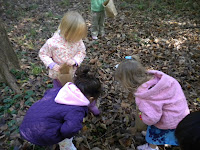
We looked high.............


We looked low...............

And here is what we found......

"Wow, look at all the leaves on the ground." "I think I see a bug." "Hello bug, are you there?"
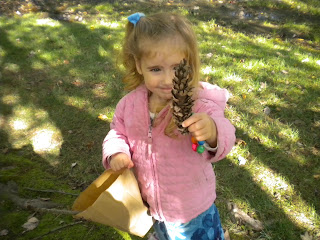
"Look Morah, I found a pine cone like in the book." "I'm going to bring it to class."


"Look up there, I see some red and orange leaves." "The other leaves are still green, they're not red or orange, they didn't change colors yet."

"I found some leaves on the grass, I'm going to put them in my bag so I can bring them to class."
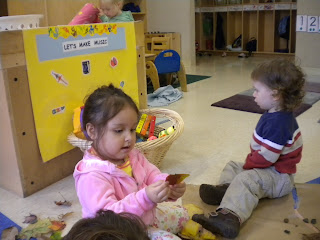
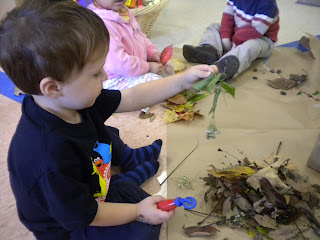
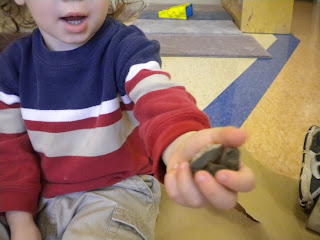
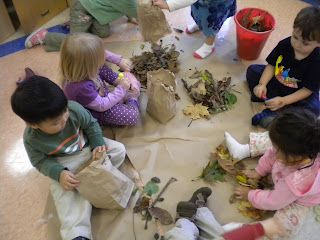
Later in class we took a closer look at all the leafy treasures we found on our nature walk. We touched the, we smelled them, we shared what we know and learned about them and finally we concluded that signs of autumn are most certainly all around.


Here we are exploring what we found.

"I found this leaf on the ground, this leaf is red and yellow."

"I got a lot of leaves and sticks, this leaf is green."

"I found some rocks outside."

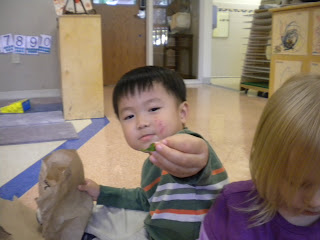
"I'm looking at this tiny leaf, it's green with a little bit of yellow."

"You want to see...... Look........."

"Leaves are messy but that's OK because we all work together to clean up."

Tuesday, April 27, 2010

We discover the world and everything outside of ourselves through our bodies and through our five senses.
We are scientists in the making. We are equipped with our appropriate tools, our five senses, to help us engage and learn about the world we live in. There is so much to uncover, discover and investigate in the budding season of spring and we are taking advantage of that.

We use our noses to smell the abundant smells of spring: the air, the soil, the flowers, the forest, the trees and whatever else grabs our attention. We smell different flowers and see if their smells are similar to each other.

We touch and try to get our hands on everything. But touch is not exclusive to our hands.
Our skin is the body’s largest organ so we can feel the world through our skin all over our bodies; rolling in the grass, walking barefoot, digging deep in the soil and making outdoor soil soup.

We stop and listen and take in the sounds of spring. What life is happening around us? Can we detect any animals or birds outdoors. Can we name what we hear? We can listen to the sound of the wind blowing through the tree branches, or through wind catcher. We can hear the sounds of the active or slow flowing river.

There is so much to see and let our eyes take in the beauty of the world.
We spend lots of time outdoors noticing the details in nature. Little ants crawling on the tree branches or daddy longlegs crawling on the bike path; we see little grass growing in the cracks of the cement and flowers beginning to bud on the trees.


Now that spring is here we can begin to prepare vegetable seeds to plant in our outdoor garden. Soon we will be able to taste the ‘fruits of our labor.’ We have been sampling and tasting some the yummy fruits of the season as we learn more about fruit and vegetable seeds and share snacks of fresh cut fruit and vegetables and look for their seeds, peel and learn the many ways to describe them.

As we use our senses to discover the world we are using our mind, body and emotion to process all that we are learning. Along the way we will be enhancing many skills that help us connect what we see, hear, smell, taste and touch to a level of understanding. We will enhance our logical thinking skills, observation skills, social emotional skills and of course, we will be enjoying the growth and freedom that nature represents.

Each fruit has it's own unique characteristics. We are learning ways how to describe the things that we see. One way we can stop to notice things is to ask ourselves questions to help us concentrate on specific areas. Therefore we are asking ourselves questions to help us notice the some of the details. Come ask along with us. Try asking your child these questions at home when you are preparing some fruits and vegetables for dinner, snack or lunch:
  • Where are my seeds located? -inside or outside of the fruit,
  • Do I have a peel, if so can I eat it?
  • Can you eat my seeds?
  • What size are my seeds?
  • What color is my inside and my outside?
When we ask ourselves these questions then we begin to put our information together to realize that even though fruits and vegetables may look different from each other could there be some things they have in common? A kiwi and a banana look and taste very different yet there are some things about them they share in common. Bananas and kiwis are both fruit, they have little tiny seeds, their seeds are found inside the fruit and we can eat the seeds. Pretty amazing information for us to process, to see similarities between things that may appear so different.
Here are some photos of us investigating and enjoying natures treats.
Thank you to all our friends for bringing in these yummy snacks.Soon we will be sampling more fruits and vegetables. We are waiting for the mangoes in our classroom to ripen so we can investigate them as well as avocados. We will keep you posted.

Morah Batsheva

Thursday, April 22, 2010

Today we celebrated Olivia's 3rd birthday.
The children designed the birthday celebration with making her birthday presents, playing a music game, singing happy birthday and eating delicious chocolate cake that we baked. Birthdays are special times as it is a sign of our growth and maturity we have accomplished. It is also a time when we can look forward to our continuous growth we wish to accomplish in the upcoming years.
We would like to thank the past few birthday friends for the gifts they have donated to the class in honor of their birthdays. Delia, thank you for the new book in our library and Olivia for the new ABC puzzle.
I would like to share with you the process the children go through to prepare for each of their friends birthdays to help make this moment a meaningful one.


Monday, April 12, 2010

Welcome spring.

The beautiful season of spring has arrived and there are signs of spring everywhere.


How do we describe spring? One way of learning about spring is by contrasting it to the last season and pointing out differences and similarities.

During the winter time we used a large picture diorama that reflected the habitats of animals and the quietness of winter outdoors. We are revisiting the image and inviting all the sleeping hibernating animals to wake up since the weather is ready for them to be outdoors. We are inviting all the birds to fly back to New Jersey and enjoy the warm weather here. We are inviting all the trees and plants to wake up and begin to grow fresh leaves and flowers again. All the snow has melted and we packed away our warm, heavy jackets boots and gloves.

Spring is here and that means rebirth and renewal.


Now that they soil has begun to soften from the warm weather life underfoot is becoming very noticeable and alive. In class today we found a 'friend' outdoors and welcomed it into our classroom. We built a home for our friend and are inviting you to take a look at it and play with it. Can you guess who we found outside? We made a game for you to help find out who it is.


Can you guess who is living inside the box?

We made up some clues to help you:

  • It lives in the mud-dirt
  • It swiggle, wiggle and waggles
  • It has no legs
  • It is only straight
  • It comes out in the rain or when the soil is wet.
  • It is very quiet


Do you think you know what it is?


It is a worm, lots and lots of worms.
Come take a look. We are very fascinated by them.

Continue to share more with you,
Morah Batsheva